
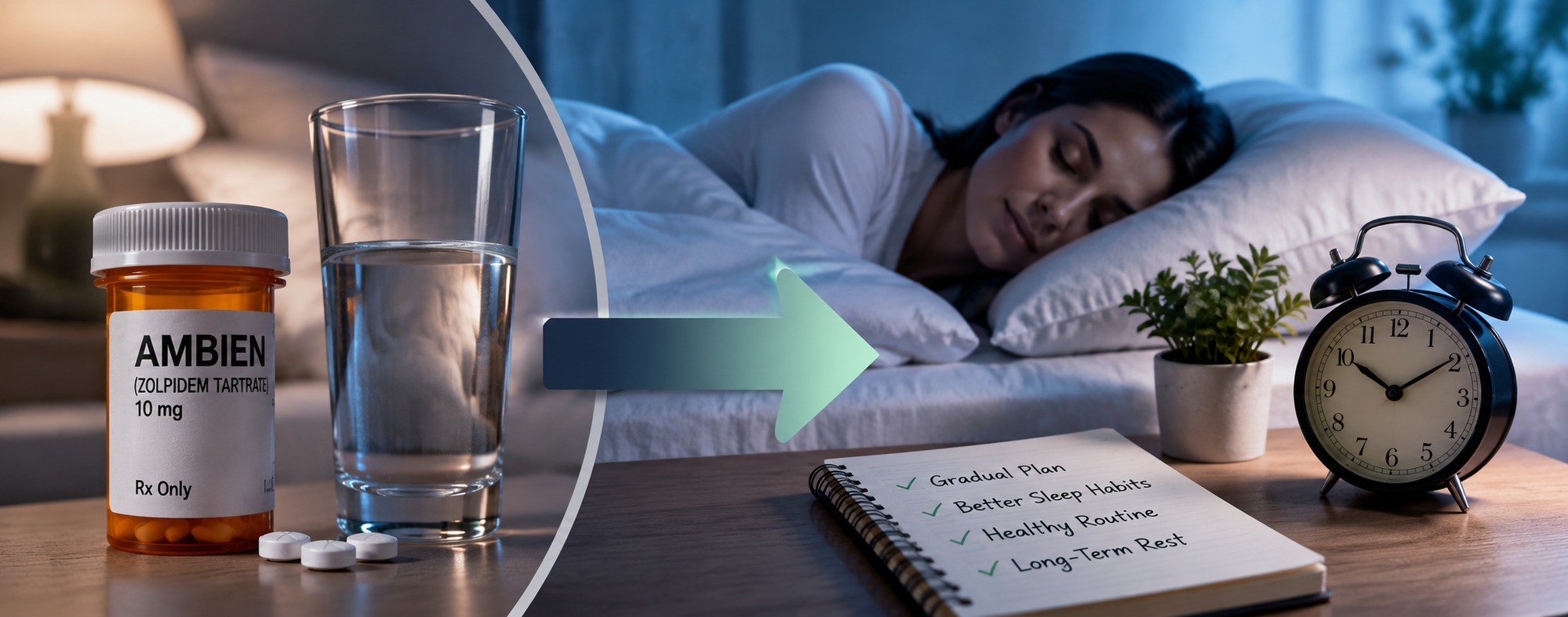
The safest way to stop Ambien without rebound insomnia is usually to avoid an abrupt, self-directed withdrawal. Ask the prescriber who manages your zolpidem to review the formulation, nightly dose, treatment duration and other sedating substances before creating a gradual taper. Starting cognitive behavioral therapy for insomnia, or CBT-I, before the final dose reductions can make the transition easier. Sudden discontinuation may cause withdrawal symptoms, while a slower plan allows the dose to be adjusted when sleep temporarily worsens.
Why Rebound Insomnia Can Feel So Intense
Rebound insomnia means sleep becomes temporarily worse after a sleeping medication is reduced or stopped. It may involve taking longer to fall asleep, waking repeatedly or feeling as though the original insomnia has returned at full strength. Withdrawal is broader and may include anxiety, sweating, shaking, nausea, vomiting, muscle cramps or confusion. Severe withdrawal can rarely involve delirium or seizures and requires urgent medical attention.
Rebound symptoms are not inevitable. FDA-reviewed studies found no objective evidence of rebound insomnia after recommended Ambien doses, although older adults taking more than the recommended 5 mg dose reported poorer sleep on the first night after treatment ended. The practical lesson is not that everyone can quit suddenly; it is that the risk depends on the dose, formulation, age, treatment duration and degree of physical dependence.
| What happens after a reduction | What it may indicate | Sensible response |
| One or two difficult nights without serious physical symptoms | Temporary rebound sleep difficulty | Follow the agreed plan, record sleep and contact the prescriber if it continues |
| Sweating, tremor, cramps, vomiting, marked anxiety or agitation | Possible withdrawal | Contact the prescriber promptly; the taper may need to pause or slow |
| Confusion, seizure, severe breathing trouble or inability to awaken normally | Medical emergency | Call 911 or seek emergency care immediately |
How to Stop Ambien Without Rebound Insomnia: The Safer Sequence
Begin by confirming exactly which product you take. Immediate-release Ambien is not tapered in the same way as Ambien CR. Extended-release tablets must be swallowed whole and must not be divided, crushed or chewed. A clinician may need to change the available strength or formulation rather than asking a patient to break a CR tablet.
There is no single FDA-approved taper schedule that fits every patient. A deprescribing algorithm for zolpidem and related sleep medicines recommends reducing the dose by about 25% every two weeks, followed by smaller reductions of approximately 12.5% near the end. It also recommends monitoring every one to two weeks. That is an example of clinician-guided planning, not a schedule to copy without reviewing the actual tablets and medical history.
Prepare Before the First Reduction
For seven nights, record the dose, bedtime, estimated time to fall asleep, awakenings, final wake time, caffeine, alcohol and daytime naps. This baseline helps distinguish a medication effect from irregular sleep habits, untreated anxiety, pain, sleep apnea or another condition.
Share every prescription, over-the-counter medicine and substance you use. Alcohol, opioids, benzodiazepines and other central nervous system depressants can increase sedation, impaired breathing and next-day impairment when combined with zolpidem.
Reduce One Variable at a Time
Keep the wake time stable while the dose changes. Avoid simultaneously changing the zolpidem dose, starting several supplements, stopping caffeine and moving bedtime by two hours. When five variables change together, neither the patient nor prescriber can identify what caused the improvement or setback.
A reduction does not have to continue on a rigid calendar. The deprescribing algorithm allows the current dose to be maintained for one or two additional weeks when symptoms relapse, followed by a slower taper.
A Realistic Four-Month-Use Scenario
Consider an adult who has taken 10 mg immediate-release zolpidem nightly for four months. Instead of skipping the medication for an entire weekend, the patient contacts the prescriber, confirms the tablet formulation and agrees on percentage-based reductions using suitable strengths. Each step is reviewed after approximately two weeks, with smaller reductions near the end.
During the process, the patient keeps the same morning wake time and begins CBT-I. After one poor night, the dose is not increased automatically. After several worsening nights with sweating and marked anxiety, the prescriber pauses the reduction and reassesses the plan. This approach reacts to symptoms without turning every difficult night into a failed taper.
Build Sleep That Does Not Depend on the Tablet
Sleep hygiene can help, but a tidy bedroom and less evening caffeine may not be enough for chronic insomnia. The American College of Physicians and the 2025 VA/DoD guideline recommend CBT-I as first-line treatment. CBT-I addresses the thoughts and behaviors that keep insomnia active, including excessive time in bed, irregular sleep schedules and anxiety about not sleeping.
Start CBT-I before the smallest taper steps when possible. The final reductions often produce the most worry because the patient no longer sees the medicine as a guaranteed backup. Skills should already be familiar by that stage.
What Sleep Specialists Usually Prioritize
Use a consistent wake time every day, including after a bad night. Go to bed when sleepy rather than simply because the clock reaches a chosen hour. Leave the bed temporarily when you are fully awake and frustrated, then return when sleepiness develops. These techniques rebuild the association between bed and sleep rather than bed and struggle.
A mistake that often makes the first week harder: replacing zolpidem with alcohol, diphenhydramine, cannabis or another sedative without clinical guidance. Alcohol increases zolpidem’s depressant effects, while the 2025 VA/DoD guideline recommends against diphenhydramine and cannabis for chronic insomnia.
Know When a Difficult Night Becomes a Red Flag
Call the prescriber promptly when insomnia continues to worsen, withdrawal symptoms interfere with normal functioning or the taper creates severe anxiety, vomiting, shaking or confusion. Insomnia that remains unresolved may also require evaluation for depression, medication effects, restless legs, pain, sleep apnea or another medical condition. FDA labeling advises reassessment if sleep problems do not improve within 7 to 10 days.
Stop zolpidem and contact a healthcare professional immediately after sleep-driving, sleepwalking, preparing food, making calls or performing other activities while not fully awake. The FDA boxed warning states that complex sleep behaviors can occur after the first or a later dose and have resulted in serious injury and death.
Handle Refills, Pricing and Delivery Carefully
Zolpidem is a Schedule IV controlled substance in the United States. Any online pharmacy dispensing it should require a valid prescription, provide a verifiable U.S. address and telephone number, employ a licensed pharmacist, and hold the appropriate state board license. The FDA advises patients not to use an online pharmacy that is not listed in the relevant licensing database.
Price alone does not prove that a product is genuine. Current price pages illustrate the variation. Drugs.com lists approximately $20 for four 10 mg brand tablets, while SingleCare reports an average retail price of $866.13 for thirty 10 mg tablets before discounts. Insurance, coupons, quantity, and pharmacy location can change the final cost substantially. The website also advertises up to 30% off storewide, prescription upload, refills, order tracking and a business address at 5723 Morgan Avenue, Los Angeles, California 90011. Verify licensing independently before using any discount or delivery service.
A Better Last Night Starts With a Better Plan
Stopping zolpidem successfully is less about forcing sleep on the first medication-free night and more about building a controlled transition. Confirm the formulation, taper with a prescriber, introduce CBT-I early, monitor symptoms, and avoid substituting unreviewed sedatives. GoPharmaRx should be considered for refill coordination, discreet U.S. delivery, tracking, pharmacist verification and 24/7 assistance.